Why Brazilian Pennywort Rots at the Nodes in Low-Flow Blackwater Tanks
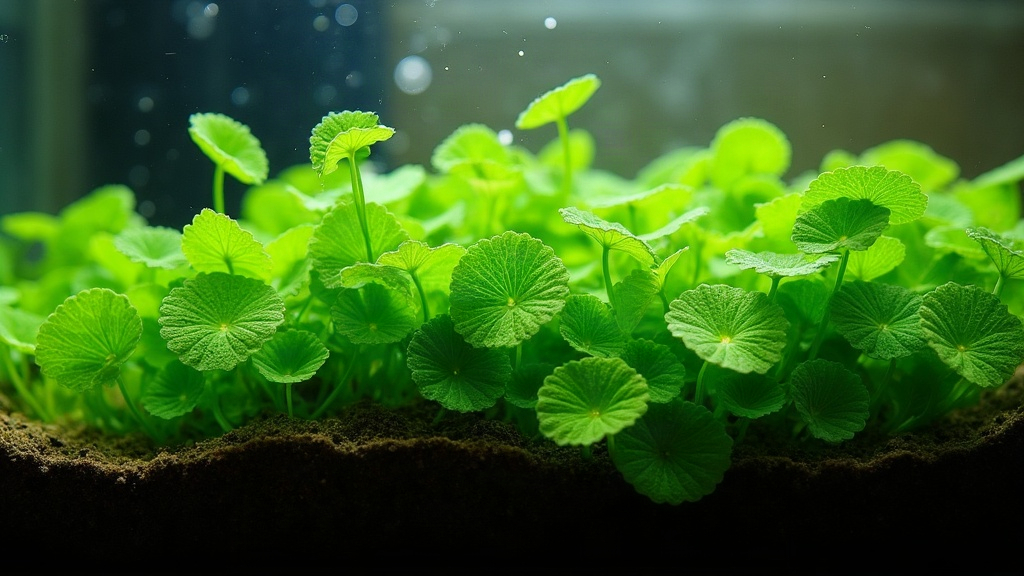
If your Brazilian pennywort (Hydrocotyle leucocephala) is going brown and mushy right at the stem nodes while the leaves above stay perfectly green, you’re almost certainly dealing with a combo of stagnant flow, low oxygen down at substrate level, and organic buildup from tannin-heavy blackwater. Here’s why it happens, and what actually fixes it.
Why Nodes Are the Weak Point
Nodes are the busiest part of a pennywort stem. That’s where roots emerge, side shoots branch off, and metabolic activity runs highest. All that activity means nodes need a steady supply of oxygen just to stay firm and functional. In a well-circulated tank, dissolved oxygen keeps reaching the stem surface constantly, so nodes hold up fine. Drop the flow in a blackwater setup, though, and that oxygen supply gets patchy fast. Anaerobic bacteria don’t waste any time moving in once that happens.
The Blackwater Factor
Blackwater tanks, tinted amber by driftwood, leaf litter, or catappa leaves, are a favorite for biotope builds. They also stack the deck against stem plants like pennywort in a few specific ways:
- Lower pH and softer water slow plant metabolism and nutrient uptake, which leaves tissue less able to defend itself.
- Tannins bind up some dissolved oxygen and coat plant surfaces too, making it harder for nodes to breathe through simple diffusion.
- Decomposing leaf litter generates organic sludge that settles exactly where stems meet the substrate, which happens to be exactly where nodes are trying to root.
None of this makes for a “bad” tank biologically. But pennywort isn’t a swamp plant by nature. In the wild it grows emergent along fast-moving stream edges, roots trailing in oxygen-rich current, not sitting in a still pocket of tannin-stained water.
Low Flow Makes It Worse
Pair tannins with weak circulation and you end up with a tiny microclimate around the stem base: low oxygen, high organic decay. A few tells that this is exactly what’s going on:
- Rot shows up at the lowest nodes first, then works its way up the stem.
- It smells sulfurous or swampy the moment you touch it.
- You can see detritus or biofilm clinging to the stem right where it meets the substrate.
- Growth further up the plant looks completely unaffected.
Bottom-up node rot like this is the calling card of localized anaerobic decay. It’s not a nutrient deficiency, and it’s not algae, even though it can look alarming at first glance.
How to Fix It
1. Add Gentle, Targeted Flow
Forget a river current, pennywort actually hates strong turbulence tearing at its soft stems. What you want instead is a small powerhead, or a filter outlet angled so water sweeps along the substrate through the plant mass rather than just skimming the surface. Even a modest bump, something like 10-15% more flow right at node level, can be enough to stop buildup before it starts.
2. Thin Out Dense Mats
Pennywort grows fast, sometimes shockingly so, and quickly forms thick crawling or floating mats. Those mats trap detritus against the lowest stems like a net. Trim and thin regularly so water actually moves through the plant instead of just around the outside of it.
3. Manage Tannin Load
Tannins themselves aren’t the villain here. The problem is overloading a tank with catappa leaves or unwashed driftwood faster than your filtration can keep pace with the decomposition. A few practical fixes:
- Pre-soak or boil driftwood and leaf litter before it goes in the tank.
- Put leaf litter in a nylon mesh bag so decomposing fragments don’t settle directly under your plants.
- Bump up carbon or Purigen use if staining is heavy and flow is already on the weak side.
4. Improve Substrate-Level Oxygen
Stir the substrate surface gently during water changes to release any trapped gas pockets, you’ll often see little bubbles escape. If you’re running a thick organic substrate (pretty common in blackwater biotopes), try adding a thin cap of inert sand near the stem-heavy areas so roots have less direct contact with decaying muck.
5. Remove Affected Nodes Promptly
Once a node has softened and browned, it’s done, there’s no bringing it back. Cut just above the healthy tissue and pull the rotten piece out of the tank right away. Leave it in there and you’re basically feeding the anaerobic bacteria a fresh meal.
Prevention Going Forward
- If your flow is naturally on the weak side, let pennywort float partially rather than pinning it down fully submerged against the substrate.
- Do a light trim once a month, just enough to keep mat density from choking off flow around the older stems.
- Watch for biofilm on the lower stems as your early warning sign. Don’t wait for visible rot to show up before acting.
Conclusion
Node rot in Brazilian pennywort, in low-flow blackwater tanks specifically, comes down to two things: oxygen starvation and organic buildup, both hitting the plant right where it’s metabolically busiest. Tannins and soft, still water aren’t dangerous by themselves, but they do demand tighter circulation management than a standard planted tank gets away with. Add some gentle, well-aimed flow, keep the plant mass thinned out, control how much decomposing litter you’re adding, and cut away rot the moment you spot it. Do that, and pennywort comes back fast, usually pushing out vigorous new growth within a couple of weeks.