Snag-Free Hardscape for a Blind Cave Tetra Subterranean Biotope
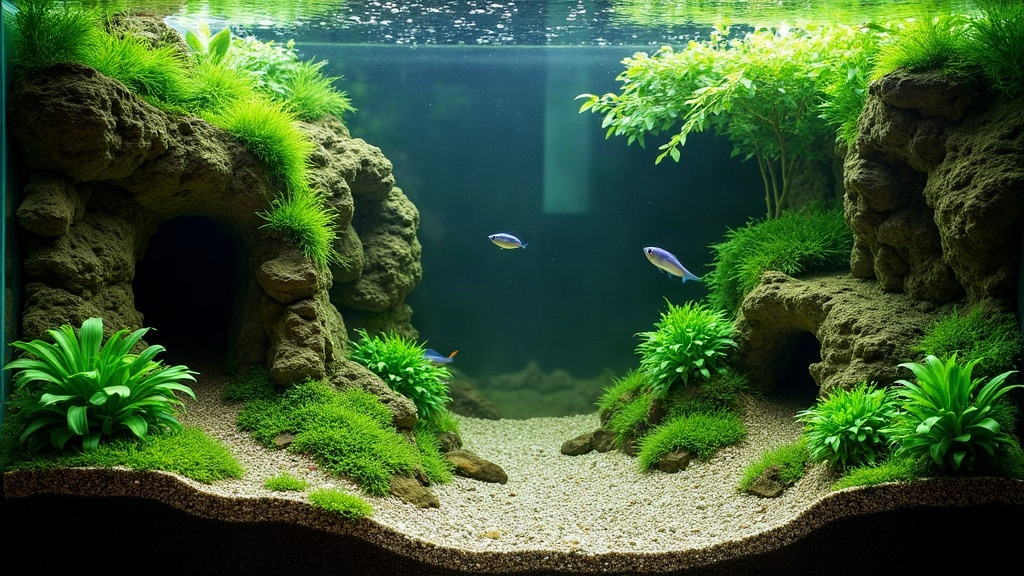
Building a Snag-Free Hardscape for Blind Cave Tetras
Designing a safe hardscape for a blind cave tetra biotope comes down to three things: smooth materials, open swimming lanes, and structures that never move. These fish have no functional eyesight, so they’re navigating almost entirely by lateral-line sensitivity to pressure and vibration. Blind cave tetras (Astyanax mexicanus) don’t “see” a rock coming. They feel the water displacement it creates, often a split second before contact. That means every stone, root, and crevice in your tank is a tactile hazard, not a visual feature. Get the layout wrong and you’ll end up with torn fins and stressed fish. Get it right and you’ve built something close to the actual Mexican limestone caves these tetras have called home for thousands of generations.
Why Standard Aquascaping Rules Don’t Apply
Most hardscape guides assume a fish that can look at a gap, judge the distance, and swim around it. Cave tetras can’t do that. They move fast, and they only register an obstacle at the last possible moment, once the pressure wave bounces back. That flips your priorities around:
- Sharp edges aren’t just ugly, they’re dangerous. A chunk of slate with a jagged fracture line might look perfectly natural in a planted tank. In a cave tetra tank, it’s a fin slicer waiting to happen.
- Tight gaps become traps. A fish trying to interpret an echo in a narrow space can wedge itself in without warning, and juveniles are especially prone to this.
- Loose rockwork isn’t a maintenance inconvenience, it’s a real hazard. One shifted stone can pin a fish or cave in a tunnel entirely.
Choosing the Right Materials
Rock Selection
Stick to naturally smooth, water-worn stones that echo real limestone cave formations:
- River-worn limestone or dolomite, authentic to the biotope and already rounded by years of water flow
- Smooth river rock, cheap, easy to find, and forgiving to work with
- Seiryu stone, sanded edges only, skip any piece with visible fracture lines
Steer clear of lava rock, raw slate, and porous stones with jagged pockets. They photograph beautifully in a standard aquascape, but for a fish navigating purely by touch, they’re abrasive and completely unpredictable.
Driftwood and Roots
Spiderwood and manzanita work well, but only after you’ve sanded down every thin, pointed branch tip by hand. Soak and cure the wood completely before it goes in the tank. Uncured wood can shift later or shed small splinters, and neither is something you want near a fish that can’t see it coming.
Synthetic Cave Structures
3D-printed or resin cave inserts have become a go-to option for cave biotopes, and for good reason: they can be molded with interior surfaces so smooth that no natural stone can really match it. If you go this route, look specifically for aquarium-safe resin products marketed for cave or cichlid setups, not generic decor.
Layout Principles for a Snag-Free Cave System
- Build wide tunnels, not narrow crevices. A cave entrance needs to be at least twice the fish’s body width to avoid wedging. For a 3-inch tetra, that’s roughly 3 to 4 inches across, minimum.
- Keep the main channel open. Aim to leave 60 to 70% of the floor space as clear, unobstructed lanes. These fish need room to cruise without interpreting an obstacle every two inches.
- Anchor everything, permanently. Aquarium-safe epoxy or polyurethane foam should bond your rockwork into one solid, immovable mass. Stacked stones that rely on gravity and good luck are not an option here.
- Round off every exposed edge. Run your bare hand over every surface before it touches the water. If it catches on your skin, it’ll catch on a fin.
- Design for depth gradients, not dead ends. Gentle slopes and looping paths beat closed pockets. A dead-end crevice is exactly the kind of spot a curious tetra investigates and then can’t back out of easily.
Substrate Considerations
Go with fine sand, not gravel. Sand mimics the silty floor sediment found in the Mexican cenotes these fish actually come from, and it won’t scrape up sensitive barbels or skin while the fish forage along the bottom. Sharp crushed coral and jagged gravel have no place in this setup.
Lighting and the “No Visual Cues Needed” Advantage
Here’s one place where biotope accuracy and practical safety line up nicely: since these fish don’t use sight at all, you can run the tank under very dim lighting, or skip it almost entirely. Lower light tends to calm the fish down too, which matters because most hardscape injuries happen during stress-driven bursts of fast swimming, not calm cruising.
Maintenance Checks
- Check the hardscape once a month for any stone that’s shifted, or any new sharp edge that’s appeared after scrubbing off calcium buildup.
- Look at fins weekly. Fraying is usually the first sign that something in the layout needs fixing.
- Replace or re-sand driftwood pieces as they age and start to splinter.
Conclusion
A good blind cave tetra biotope was never about visual drama in the first place. It’s about tactile safety, full stop. Smooth, rounded materials. Generously wide tunnels. Structures that don’t budge. Open lanes instead of tight, intricate rockwork that looks impressive but does nothing for the fish living in it. Get those fundamentals right and your hardscape will do its job twice over: keep the fish safe, and genuinely recreate the limestone world they evolved to live in.