Kessil Pendants vs Chihiros WRGB Bars for Iwagumi Shadow Contrast
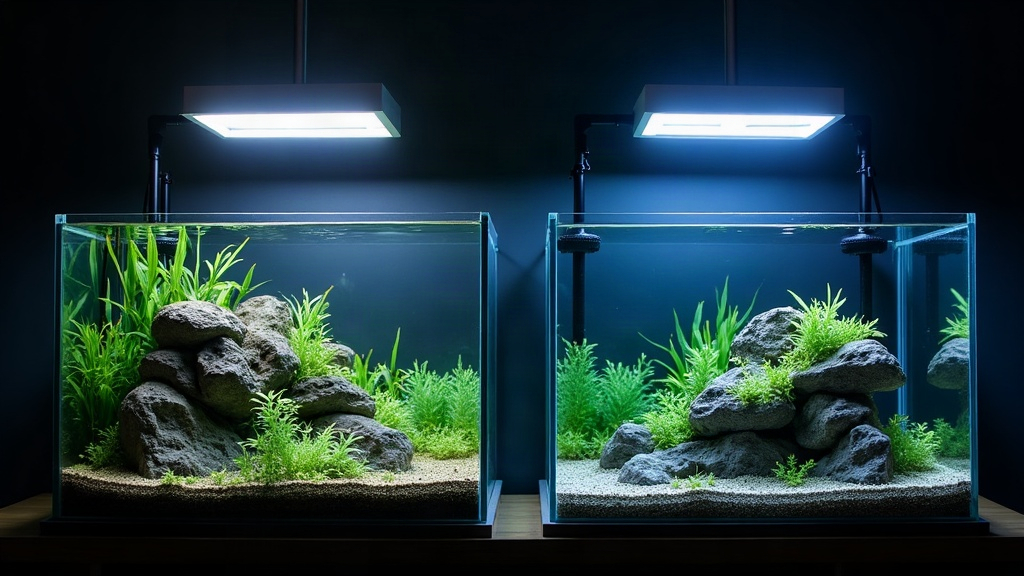
If you’re chasing dramatic, high-contrast shadows across your Iwagumi stones, Kessil pendant spotlights beat Chihiros WRGB bars almost every time. The reason is simple physics: point-source LEDs throw sharp, directional shadows that a linear bar just can’t fake. Chihiros bars are great at giving even, shadow-free coverage across a planted tank, but that same evenness is exactly what flattens the rock relief that makes an Iwagumi scape worth photographing. Let’s dig into why the shape of the light matters more here than brightness or color spectrum ever will.
Why Light Shape Matters More Than Light Spec Sheets
Most hobbyists shop by PAR, wattage, or Kelvin rating. None of those tell you what you actually need to know for Iwagumi contrast, which is how large the light source appears relative to your tank.
- A small, concentrated point source (think Kessil A160 or A360) throws hard-edged, elongated shadows, a bit like direct sun hitting a mountain ridge at 7am.
- A wide, diffuse linear source (a Chihiros WRGB II or WRGB II Pro bar) bathes objects in light from dozens of angles at once, which softens or outright erases shadows, similar to shooting under an overcast sky at noon.
Photographers have known this for decades: a small flash gives you drama, a softbox gives you flattery. If you’re after that “mountain range at dawn” mood in your Iwagumi, you want the flash, not the softbox.
Kessil Pendant Spotlights: The Point-Source Advantage
Kessil’s A-Series (A160 Tuna Sun, A360X) and the newer A500 line pack their LED arrays into a tight reflector housing that hangs above the tank rather than stretching across it.
Strengths for Iwagumi:
- Hard shadow lines carve out stone ridges and crevices, exaggerating texture in a way that reads instantly in photos.
- Shimmer on the substrate and glass, that rippling light dance scapers obsess over because it signals “natural sunlight” to the eye.
- Adjustable height and angle: raise the pendant, tilt it off-center, and you’re essentially moving the sun. Shadow length and direction become dial-in parameters.
- A clean, minimal look with nothing spanning the top of the tank, so your eye goes straight to the hardscape instead of the fixture.
Trade-offs:
- A single pendant covers maybe 12 to 24 inches depending on model and mounting height. Past 36 inches you’re probably running two units, and then you have to watch for overlapping shadows canceling out the drama you wanted.
- Cost per PAR is noticeably higher than a bar.
- Getting the height right takes some trial and error: too low and the edges go dark, too high and you lose the shadow punch.
Chihiros WRGB Bars: Even, Shadow-Minimizing Coverage
Chihiros WRGB II and WRGB II Pro bars run rows of RGB plus white LEDs along nearly the full length of the tank, all tunable through an app with spectrum curves you can save as presets.
Strengths:
- Uniform PAR edge to edge, which matters a lot if you’re trying to carpet the whole floor with Eleocharis or Hemianthus callitrichoides and don’t want patchy growth.
- Better value, honestly. One bar often costs less than the two Kessil pendants you’d need to cover the same footprint.
- Spectrum control that actually does something: sunrise/sunset ramps, custom red-heavy ratios to pop your Rotala or Ludwigia colors.
Why it falls short on shadow contrast:
- Light coming from multiple points along the bar fills in shadows from every direction, so stone relief ends up soft and diffused.
- Shimmer is barely there, if it shows up at all.
- Your stones look great in person but go “flat” in photos, even when the plants are thriving.
Can You Combine Approaches?
Absolutely, and some competition scapers already do this. Run a Chihiros bar at reduced intensity as a general fill light, then add a single Kessil pendant angled in from one side as your key light. It’s basically a two-point photography lighting rig, applied to a fish tank. The hybrid setup gets you:
- Even growth everywhere in the tank.
- Real directional drama on the hardscape.
- Independent control over contrast and total PAR, so you’re not trading one for the other.
It costs more and takes more fiddling to dial in, but for a competition-grade layout, this is how you get both a thriving carpet and a stone arrangement that looks sculpted by sunlight.
Quick Decision Guide
- Want maximum shadow drama and shimmer, and can live with uneven coverage and a bigger bill: go Kessil pendant(s).
- Want even growth, lower cost, serious spectrum control, and don’t mind flatter shadows: go Chihiros WRGB bar.
- Want both: dim a bar for growth, add an off-center pendant for contrast.
Conclusion
When the stones are the whole point of the layout, point-source Kessil pendants are what give you those hard, directional shadows that make a rock arrangement look three-dimensional instead of just, well, rocks sitting in sand. Chihiros WRGB bars still earn their keep for plant health, even coverage, and price, but they can’t deliver the shadow drama serious Iwagumi scapers are after. If the budget stretches far enough, pairing a bar for growth with a pendant for contrast gets you the most convincing, photo-ready tank you can build.